Bulgaria/Music/Instruments Pg 1
Gaïda
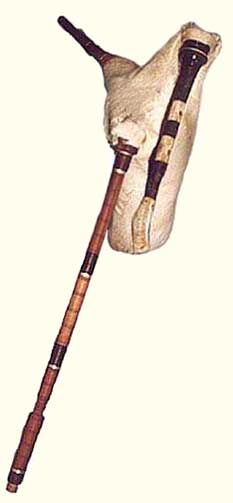
The gaïda is a Bulgarian folk instrument that belongs to the family of aerophones. It is a sort of bagpipe, a well known instrument in Europe, Asia and Africa.
There are two varieties of gaïda known in Bulgaria: the large bagpipes, called the kaba with a low register; and the small one called the djoura with a high-pitched register. The main part of the gaïda is the gaidounitza (a small wooden cylindrical chanter with eight finger holes). The upper mouthpiece includes a single beating reed on which a thread is wound to lengthen or shorten it and thus tune the instrument. The tone depends on a goose feather inserted into a small hole in the gaidounitza.
The routchilo is another part of the gaïda made of three or four wooden cylinders. A piscoune (kind of whistle) that makes a high-pitched sound is attached to the upper opening of the second cylinder.
Today, as they play, musicians change the gaidounitza and the routchilo to change the register of the instrument. The bellows or air bag made of kid or sheep skin has another wooden cylinder through which air is stored and then emptied by means of the gaidounitza and the routchilo. The gaïda is a two-voiced (chanter and drone) instrument with a limited range but with considerable rhythmic and ornamental sonority that explains why it is played in every contemporary folk group.
This audio clip is an instrumental using various instruments.
Folk Song

© Gans 2011